0


Your Cart


Product title goes here
$19.95
Thank you! Your submission has been received!
Oops! Something went wrong while submitting the form.
No items found.
I saw a dramatically curling allium at the wholesaler and was told it was “Snake Ball.” It wasn’t. Here’s what it really is, how it grows, how to condition it, and why it’s so compelling in Rising Form.

I wasn’t looking for it.
I was at the wholesaler, scanning buckets the way we all do — branch, foliage, texture, line.
And then I saw it.
Long, looping stems. Dramatic curves. Movement that looked almost drawn rather than grown. It reminded me of plant illustrations I’ve seen in Japanese reference books — expressive, alive, unapologetically linear.
I asked what it was.
“Snake Ball Allium,” I was told.
I ordered it for our upcoming class.
Only later did I learn that the name wasn’t quite right.
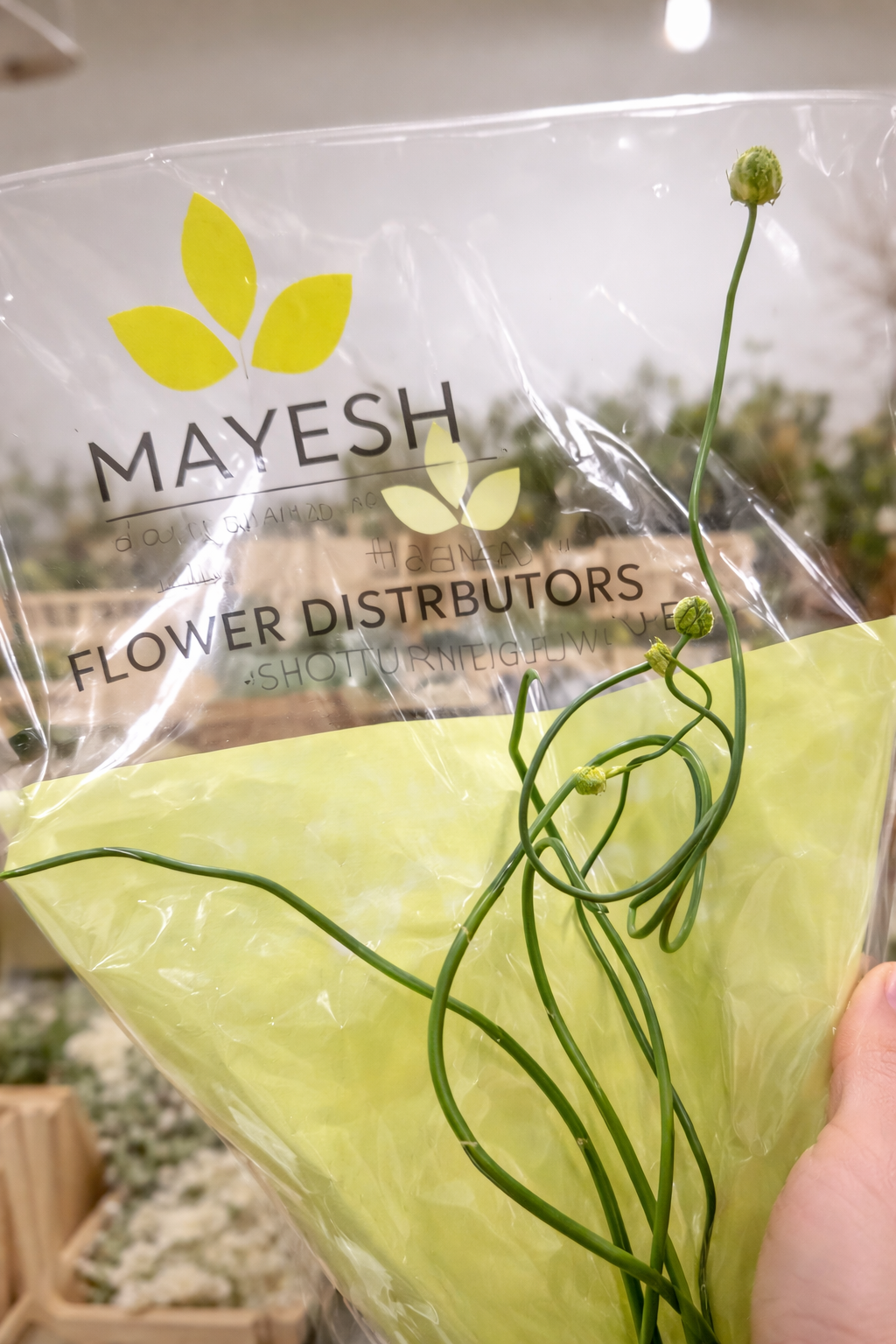
The dramatically curling allium often sold in the floral trade as “Snake Ball” is typically Allium vineale ‘Hair’, sometimes marketed as:
True “Snake Ball Allium” more properly refers to Allium sphaerocephalon (Drumstick Allium), which grows mostly upright and produces small burgundy oval flower heads.
The curly form is different.
Plant names in the cut flower trade are sometimes used loosely. When growth habit matters — and in ikebana it absolutely does — confirming the botanical name helps ensure you receive what you expect.
In this case, the surprise was delightful.
Genus: Allium
Family: Amaryllidaceae
Hardiness Zones: 4–8
Light: Full sun
Soil: Well-drained soil is essential
Unlike the upright drumstick allium, this form produces naturally looping, twisting stems. The flower heads are small and textural, often appearing as clustered bulbils rather than classic spherical blooms.
In some regions, Allium vineale can naturalize readily and should be planted thoughtfully.
Plant bulbs in fall.
Once established, it returns reliably.
The curling stems are a natural growth habit — not forced, not trained. That organic movement is what makes it so visually compelling.

In my Japanese plant references, I did not find an entry specifically for this curly form.
However, I did find an entry for Allium cowanii, another ornamental allium species.
Its handling note is beautifully simple:
“Water absorption is good; flowers will last about 10 days.”
There is no mention of scorching, crushing, or special techniques — just good water uptake and reasonable longevity.
While species differ, ornamental alliums share similar stem structure and vascular characteristics. Based on that, we can reasonably expect the curly allium form to behave similarly when properly conditioned.
In practice, this proved true.
Despite its dramatic curves, ornamental alliums are straightforward to handle.
Here is what works reliably:
The stems are firm and fibrous. A fresh, clean cut improves water uptake.
Leaves yellow quickly and distract from the line.
Place stems in clean, cool water for several hours before arranging.
As members of the onion family, freshly cut stems may release a mild sulfur scent. Hydrating separately before combining with delicate materials can be helpful.
With proper conditioning, ornamental alliums typically last 7–14 days.
They do not require deep water. A moderate water level is sufficient.
Despite their apparent looseness, the stems are surprisingly strong and hold their form beautifully.
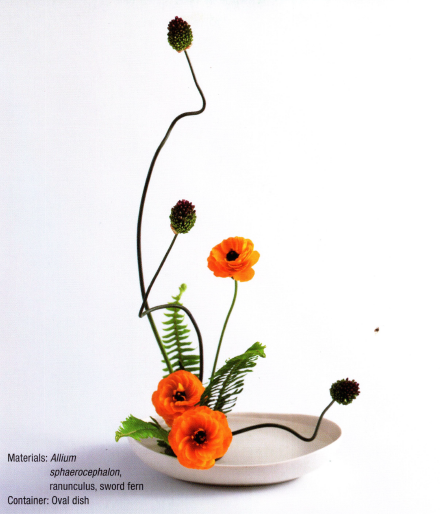
Rising Form is one of the two foundational Hana-isho forms of the Ohara School.
It expresses vitality. Lift. Direction.
The upright drumstick allium offers disciplined vertical punctuation.
The curly form offers something different:
It is not rigid.
It resists symmetry.
It introduces energy into space.
For Rising Form, that energy requires restraint. But when balanced thoughtfully, it brings extraordinary vitality to the arrangement.
When ordering specialty materials, especially in the floral trade, common names are not always botanically precise.
In this case, what I was told was “Snake Ball Allium” turned out to be something slightly different — and arguably more expressive.
The name changed.
My admiration did not.
Joe Rotella
Associate Second Term Master
Ohara School of Ikebana


