0


Your Cart


Product title goes here
$19.95
Thank you! Your submission has been received!
Oops! Something went wrong while submitting the form.
No items found.
Plum blossoms appear in the quietest part of winter, long before spring feels assured. As February’s flower of the month, plum blossom (ume) invites us to slow down, notice subtle seasonal change, and reflect on patience, resilience, and timing. This reflection explores why plum blossom matters not only as a symbol in Japanese culture, but as a quiet teacher within the practice of Ohara Ikebana.
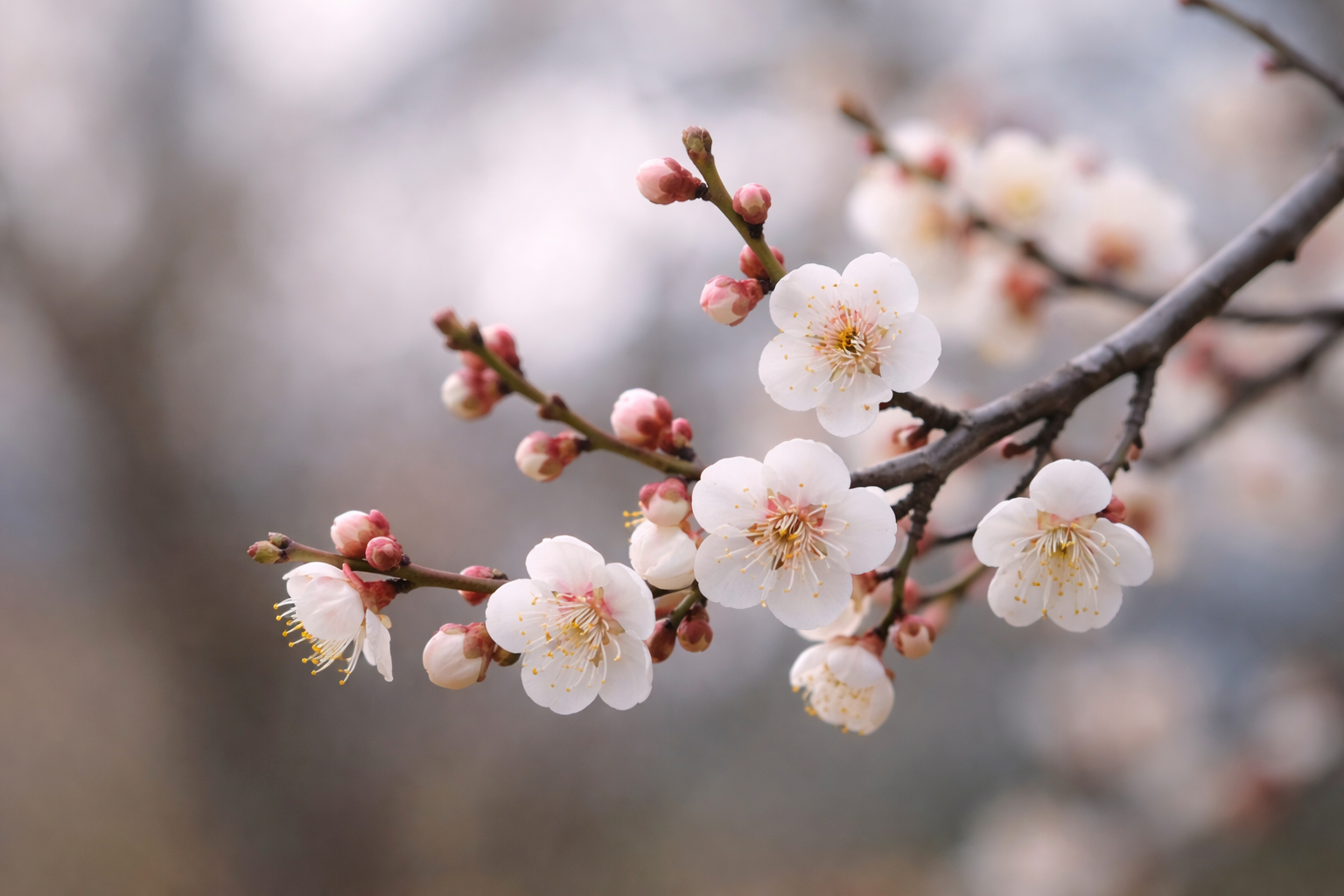
Plum blossoms arrive before the season feels ready for them.
In the depths of winter, when cold still lingers and the landscape appears unchanged, plum blossom buds quietly swell and open. There is no announcement. No sudden transformation of the landscape. Just a few blossoms, steady and self-contained, appearing while winter still holds its ground.
This early blooming is what makes plum blossom (ume) so compelling. As February’s flower of the month, plum blossom does not wait for ideal conditions. It blooms early, without spectacle, asking only that we notice.
In the practice of Ohara Ikebana, plum blossom often reminds us that timing is not always about abundance. A single branch, a few blossoms, or even tightly closed buds can communicate more than a fully open display. Plum blossom encourages restraint, attentiveness, and respect for what is present rather than what we expect to see.
There is a quiet discipline in this kind of observation. It requires patience and a willingness to slow down. In winter, that can be especially challenging. We are often eager for visible signs that the season is turning, that warmth and growth are just ahead. Plum blossom offers that reassurance, but gently and without urgency.
In this way, plum blossom becomes more than a seasonal material used in ikebana arrangements. It becomes a teacher. Not everything meaningful arrives when conditions feel comfortable or complete. Growth often begins beneath the surface, long before it is widely visible. Learning to recognize those early signs is part of deepening one’s ikebana practice.
As February begins, plum blossom invites us to stand in that in-between space. Winter is still present, yet change is already underway. If we take the time to look closely, we may realize that the season has been shifting quietly all along.
For readers interested in a deeper exploration of plum blossom—its cultural significance, symbolism, and traditional use within the Ohara School of Ikebana—you may enjoy the earlier post, Embracing the Beauty of February: Celebrating the Plum Blossom (梅 – Ume). Together, these two reflections offer different ways of approaching the same flower: one through understanding and tradition, and the other through quiet observation.
Plum blossom does not hurry us toward spring.
It simply reminds us that the process has already begun.
Joe Rotella
Associate Second Term Master
Ohara School of Ikebana


